1. Differentiate between Collection and collections in the context of Java.
Collection
Collections
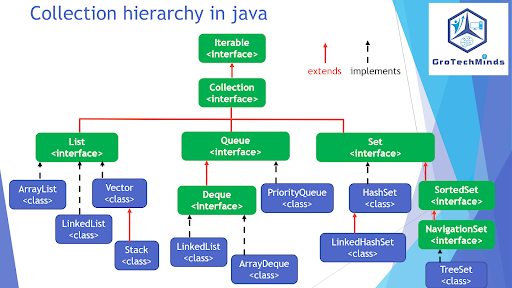
1. It is an interface. The interface can also contain abstract and default methods.
1. It is a class
2. It extends the iterable interface.
2. It extends the Object class.
3. Collection has got many interface and classes in it.
3. It has lot of methods that can be used to work on the collection.
4. It doesn’t have any direct implementation as it is an interface. But you can implement the collection interface by using various Java classes, like ArrayList, HashSet, and PriorityQueue.
4. As it is a final class, meaning it can not be subclassed. It doesn’t have any public constructors, so its methods are accessed statically.
2. Difference between ArrayList and LinkedList.
ArrayList
LinkedList
1. ArrayList acts as List
1. LinkedList acts as List & Deque.
2. The underlying data-structure of ArrayList is a growable and resizable array.
2. The Underlying data-structure of LinkedList is “Doubly LinkedList” OR “Circular LinkedList”.
3. Memory efficient. It only stores the object in the list.
3. Memory is inefficient. It stores the object and the pointers to next and previous nodes.
4. ArrayList are good for retrieval operations.
4. LinkedList are good for insertion or deletion operations.
5. ArrayList are worst for insertion or deletion operations.
5. LinkedList is the worst for retrieval operations.
3. Differentiate between ArrayList and Vector in java.
Feature
ArrayList
Vector
Synchronization
Not synchronized
Synchronized
Thread Safe?
Not thread-safe
Thread-safe
Performance
Faster due to no synchronization
Slower due to synchronization overhead
Growth Factor
Increases its size by 50%
Doubles its size
Legacy
Part of collection framework
Part of the original version of Java (1.0)
Enumeration
Uses Iterator
Uses Enumeration and Iterator
4. Differentiate between List and Set in Java.
List
Set
1. List is an Index based data Structure.
1. Set is not an index based data Structure. It stores the data according to hashcode values.
2. List Can Store Duplicate Elements.
2. Set does not allow storing duplicate elements.
3. List can store any number of null values.
3. Set can store only one null value in it.
4. List follows the insertion order.
4. Set does not follow the insertion order.
5. We can iterate (get) the list element by Iterator and ListIterator.
5. We can Iterate the set elements by Iterator only.
6. ArrayList, LinkedList, Vector and Stack are implemented classes of List.
6. HashSet, LinkedHashSet, TreeSet are implemented classes of Set.
5. Differentiate between Iterator and ListIterator in Java.
Iterator
ListIterator
1. We can get an Iterator cursor by iterator() method. Iterator itr=l.iterator();
1. We can get ListIterator cursor by listIterator() method. ListIterator litr=l.listIterator();
2. Iterator cursor can be used with any Collection object.
2. ListIterator cursor can be used with only List implemented classes. i.e. ArrayList, LinkedList, Vector & Stack.
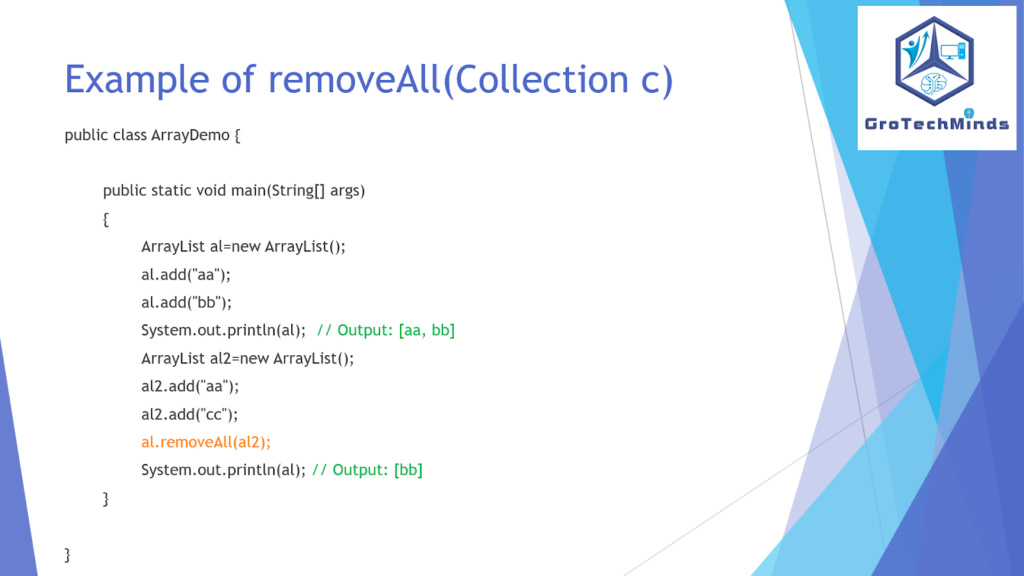
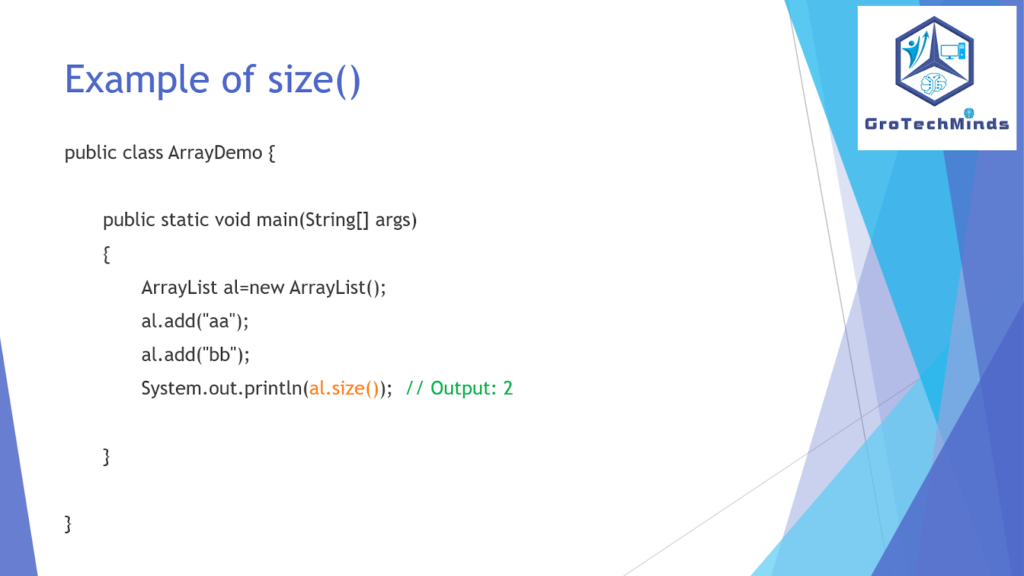
					public class ArrayDemo {

	public static void main(String[] args)
	{
		ArrayList al=new ArrayList();
		al.add("aa");
		al.add("bb");
		System.out.println(al.size());  // Output: 2

	}

}
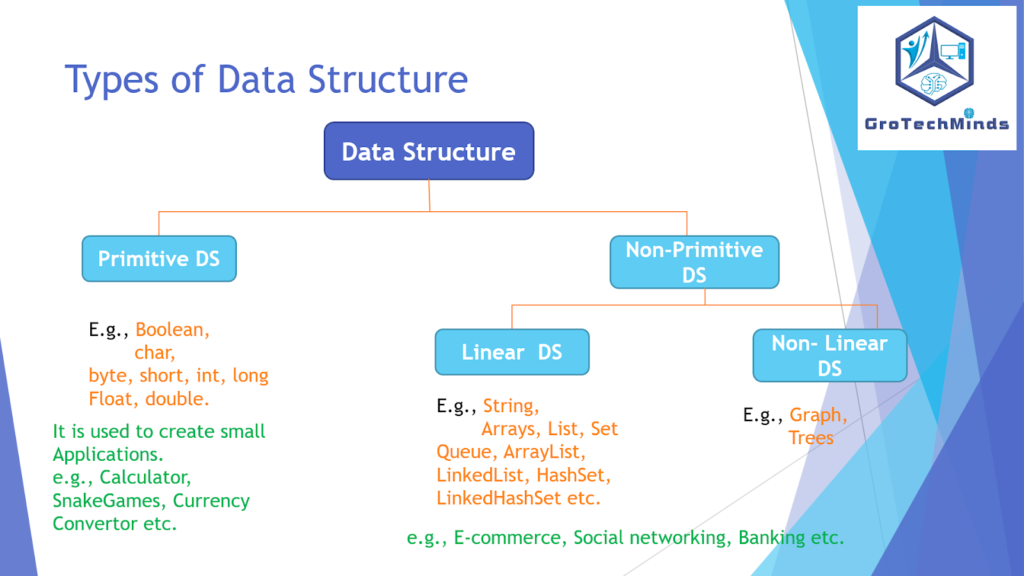
14. Types of Data Structure in Java.
15. What are cursors in Java?
A Java Cursor is an Iterator, which is used to iterate or traverse or retrieve a Collection or Stream object’s elements one by one. There are three cursors in Java.
1) Iterator 2) ListIterator & 3) Enumeration.
Enumeration is the cursor which is used to retrieve Collection objects one by one.
Enumeration was introduced in JDK 1.0 version.
Enumeration cursor can be used only with Legacy Classes. i.e. Vector & Stack.
Enumeration Cursor can be get by elements() method.
Enumeration e = v.elements();
Methods of Enumeration cursor are:-
hasMoreElements(), nextElement()
Enumeration cursor can be used to retrieve the elements only in forward direction.
Enumeration cursor can be used only for read operations.
Code Snippet:
					public class Test
{
	public static void main(String[] args)
	{
		Vector v=new Vector();
		v.add(10);
		v.add(“Jyoti”);
		v.add(15.2);
		Enumeration e= v.elements();
		while(e.hasMoreElements())
		{
			System.out.println(e.nextElement());
		}
	}
}
16. What are legacy classes in java?
In JDK 1.0 version java provides classes and interfaces in which we can store the data/Objects.
for e.g: Vector, Stack, Hashtable, Properties, Dictionary.
In JDK 1.2 version collection Framework was Introduced.
Legacy Classes:
Some classes i.e. Vector, Stack, Hashtable etc. was introduced in JDK 1.0 version but when collection framework was introduced in JDK 1.2 version these classes were modified or re-engineered so that they can be adjusted in new collection hierarchy, so these older classes are known as Legacy classes.
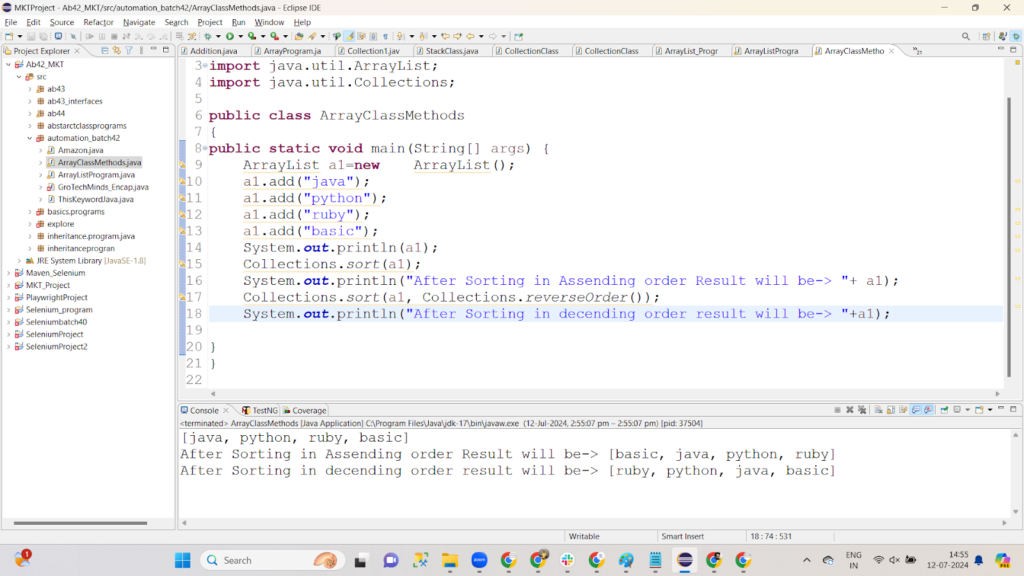
17. Demonstrate Java Collections sort and reverseorder methods.
Code Snippet:
					package automation_batch42;

import java.util.ArrayList;
import java.util.Collections;

public class ArrayClassMethods
{
public static void main(String[] args) {
	ArrayList a1=new 	ArrayList();
	a1.add("java");
	a1.add("python");
	a1.add("ruby");
	a1.add("basic");
	System.out.println(a1);
	Collections.sort(a1);
	System.out.println("After Sorting in Ascending order Result will be-> "+ a1);
	Collections.sort(a1, Collections.reverseOrder());
	System.out.println("After Sorting in descending order result will be-> "+a1);

}
}
18. Does Collection class inherit Object Class?
Yes, the Object class is the root class of the entire class Hierarchy.