AI-Powered Data Science & Machine Learning Program with Generative AI

- Description
AI-Powered Data Science & Machine Learning Program with Generative AI – Overview
AI-Powered Data Science & Machine Learning Program with Generative AI – Outcome
- Develop hands-on experience in data analysis, data cleaning, and visualization using tools such as Python, NumPy, Pandas, Matplotlib, and Seaborn.
- Learn to build and evaluate machine learning models using algorithms like Linear Regression, Logistic Regression, Decision Trees, Random Forest, and Support Vector Machines.
- Understand key concepts of Deep Learning, Natural Language Processing (NLP), and Computer Vision to build intelligent AI applications.
- Explore modern Generative AI technologies, including Large Language Models (LLMs), prompt engineering, embeddings, and Retrieval Augmented Generation (RAG).
- Gain practical experience through real-world projects such as predictive analytics, customer segmentation, AI chatbots, and intelligent data applications.
- Gain practical experience through real-world projects such as predictive analytics, customer segmentation, AI chatbots, and intelligent data applications.
Tools Covered in the Course






AI-Powered Data Science & Machine Learning Program with Generative AI Testing Course Features
- Comprehensive Curriculum
- Expert Instructors
- Interactive Learning
- Weekly Tests
- Feedback and Assessment
- Real time Projects
- Continuous Support
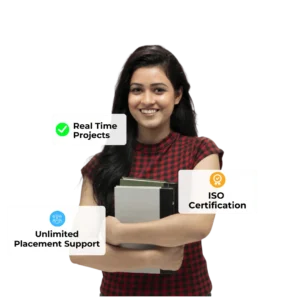
- ISO Certification
- Mock Interview
- Unlimited Placement Support
AI-Powered Data Science & Machine Learning Program with Generative AI Course Syllabus
What is Data Science?
What is Artificial Intelligence?
Data Science vs AI vs Machine Learning
Real-world applications of AI
AI in different industries
Data Science lifecycle
Overview of tools used in Data Science
Python Introduction
Python Installation & Environment Setup
Variables and Data Types
Operators
Conditional Statements
Loops
Functions
File Handling
Exception Handling
Object-Oriented Programming
Lambda Functions
Regular Expressions
Tools:
Python
Jupyter Notebook
Google Colab
Introduction to NumPy
Arrays and Matrix Operations
Introduction to Pandas
DataFrames and Series
Data Import and Export
Data Cleaning
Handling Missing Data
Data Transformation
Feature Engineering
Exploratory Data Analysis (EDA)
Libraries:
NumPy
Pandas
Introduction to Data Visualization
Data storytelling
Visualization best practices
Matplotlib basics
Seaborn visualization
Advanced plotting techniques
Dashboard concepts
Libraries:
Matplotlib
Seaborn
Introduction to Statistics
Types of Data
Descriptive Statistics
Mean, Median, Mode
Variance and Standard Deviation
Probability basics
Normal distribution
Hypothesis Testing
Correlation
Regression basics
Statistics is important because machine learning models rely on statistical analysis of data.
Introduction to Databases
SQL Fundamentals
SELECT statements
WHERE clause
ORDER BY
GROUP BY
HAVING clause
Joins (Inner, Left, Right)
Subqueries
Aggregation functions
Tools:
MySQL
PostgreSQL
Introduction to Machine Learning
Types of Machine Learning
Supervised Learning
Unsupervised Learning
Model training and testing
Feature selection
Model evaluation
Regression Algorithms:
Linear Regression
Logistic Regression
Classification Algorithms:
Decision Tree
Random Forest
Naïve Bayes
Support Vector Machines
Model Evaluation:
Confusion Matrix
Accuracy
Precision
Recall
F1 Score
Many industry programs teach these algorithms as the core ML foundation.
Clustering concepts
K-Means clustering
Hierarchical clustering
Customer segmentation
Dimensionality Reduction
Principal Component Analysis (PCA)
Introduction to Deep Learning
Neural Networks
Perceptron
Activation Functions
Backpropagation
Convolutional Neural Networks (CNN)
Image recognition
Recurrent Neural Networks (RNN)
LSTM networks
Tools:
TensorFlow
Keras
Introduction to NLP
Text preprocessing
Tokenization
Stemming and Lemmatization
Stop words removal
POS tagging
TF-IDF
Sentiment analysis
Named Entity Recognition
Libraries:
NLTK
spaCy
Introduction to Computer Vision
Image processing
Image filtering
Object detection
Face detection
Image recognition
Tool:
OpenCV
Introduction to Generative AI
What are Large Language Models (LLMs)?
Prompt Engineering
ChatGPT and LLM APIs
Embeddings and Vector Databases
Semantic search
Retrieval Augmented Generation (RAG)
Building AI chatbots
Generative AI and RAG systems are now widely included in modern AI programs.
Introduction to MLOps
Version control using Git
CI/CD for ML models
Jenkins pipelines
Model deployment
Docker basics
Monitoring AI models
Students will build industry-level projects such as:
Sales Data Analysis Dashboard
House Price Prediction Model
Customer Segmentation System
AI Chatbot using LLM
Resume Screening System
Document Q&A system using RAG
Tools Covered in the Course
Programming:
Python
Libraries:
NumPy
Pandas
Matplotlib
Seaborn
Scikit-Learn
TensorFlow
Keras
NLTK
OpenCV
Databases:
MySQL / PostgreSQL
Visualization Tools:
Power BI
Tableau
AI Tools:
OpenAI API
Vector Databases
DevOps Tools:
Git
Jenkins
Docker
- Students or recent graduates aspiring to start a career in Data Science or AI.
- Working professionals looking to upskill or transition into data science and AI roles.
- Software developers wanting to expand their skills in machine learning and AI.
- Data analysts aiming to advance their careers with machine learning expertise.
- Non-IT professionals planning to switch their careers to data science or AI.
- Tech enthusiasts or entrepreneurs interested in building AI-powered applications.







AI-Powered Data Science and Machine Learning involve using data, algorithms, and artificial intelligence techniques to analyze information, identify patterns, and build predictive models. It combines programming, statistics, and machine learning to develop intelligent systems that can learn from data. Generative AI further enhances this by enabling machines to create content such as text, images, and insights using large language models. These technologies are widely used in industries to automate processes, improve decision-making, and build smart applications.
AI-powered data science helps organizations transform raw data into meaningful insights that support better business decisions. Machine learning models can predict trends, automate tasks, and uncover hidden patterns in large datasets. With the addition of Generative AI, businesses can build intelligent assistants, chatbots, and content-generation tools. These technologies improve efficiency, innovation, and competitiveness across industries.
This course is designed for students, recent graduates, and professionals who want to build careers in data science, machine learning, and artificial intelligence. It is suitable for software developers, data analysts, and IT professionals who want to expand their skills in AI technologies. The program is also ideal for beginners and career switchers who want to enter the rapidly growing field of data science and generative AI. Learners will gain practical skills through hands-on projects and real-world tools.
Yes, AI-powered Data Science and Machine Learning are among the most in-demand careers in today’s technology-driven world. As organizations increasingly rely on data to make strategic decisions, skilled professionals who can analyze data, build machine learning models, and develop AI-powered solutions are highly valued. With the rapid growth of Generative AI and Large Language Models, career opportunities in AI are expanding across industries such as healthcare, finance, e-commerce, and technology.
If you want to start a career in Data Science and Artificial Intelligence, our AI-Powered Data Science & Machine Learning Program with Generative AI is the perfect place to begin. At GrotechMinds, we provide comprehensive training designed to equip you with the practical skills and knowledge required to succeed in the AI and data science industry. Our program covers everything from fundamentals to advanced AI techniques and is guided by industry experts with real-world experience.
There are no strict prerequisites for enrolling in the AI-Powered Data Science & Machine Learning Program with Generative AI. This course is open to anyone interested in building a career in data science, machine learning, or artificial intelligence. Whether you are a student, recent graduate, working professional, or someone planning to switch careers into the tech industry, you can enroll in this program. Even beginners with basic computer knowledge can start learning and gradually develop the skills needed to succeed in the field of data science and AI.
You don’t have to know how to code before taking the GroTechMinds AI-Powered Data Science & Machine Learning Program with Generative AI course. This program is designed for learners with different levels of technical knowledge, even if you have no prior coding experience. At GroTechMinds, we start with the fundamentals of Python programming and gradually introduce advanced topics such as machine learning and generative AI. Whether you’re new to technology or looking to build AI skills, you can confidently join this course and begin your learning journey.
The AI-Powered Data Science & Machine Learning Program with Generative AI includes several important components that help learners build strong practical and theoretical knowledge in AI and data science. Key components include Python programming, data analysis, data cleaning, data visualization, statistics, and SQL for handling and understanding data. The program also covers machine learning algorithms, model training, evaluation techniques, and deep learning concepts. In addition, learners explore advanced topics such as Natural Language Processing (NLP), Computer Vision, Generative AI, Large Language Models (LLMs), prompt engineering, and Retrieval Augmented Generation (RAG). With GroTechMinds, students gain hands-on experience through real-world projects and industry tools, helping them become skilled professionals in the field of data science and artificial intelligence.
Yes, practical learning and hands-on experience are essential for mastering data science and machine learning. The more you practice with real datasets and build AI models, the more confident and skilled you will become in developing intelligent solutions. At GroTechMinds, we focus on real-time, practical learning where students work on industry-based projects and real-world datasets. Our program is designed to provide hands-on experience in Python, machine learning, deep learning, and Generative AI, helping learners gain real-world skills while completing the course.
The AI-Powered Data Science & Machine Learning Program with Generative AI involves learning various industry-standard tools that help in data analysis, model building, and AI development. Some commonly used tools include Python, Jupyter Notebook, NumPy, Pandas, Matplotlib, and Seaborn for data processing and visualization. The program also covers SQL, Scikit-learn, TensorFlow, and Keras for machine learning and deep learning development. In addition, learners explore modern AI tools such as OpenAI APIs, vector databases, and prompt engineering techniques used in Generative AI applications. With GroTechMinds, you can master these tools and gain practical experience needed for a successful career in data science and artificial intelligence.
Yes, GroTechMinds offers additional mentorship support for the AI-Powered Data Science & Machine Learning Program with Generative AI. This mentorship program is designed to enhance the learning experience by providing deeper understanding of key data science, machine learning, and AI concepts.
Our experienced mentors support students throughout the course by guiding them during hands-on practice, real-world projects, and industry-based case studies. They also help clarify doubts, provide career guidance, and assist learners in building practical AI solutions. With this personalized mentorship, students receive continuous support that makes their learning journey more effective and rewarding.
Yes, you can enroll in the AI-Powered Data Science & Machine Learning Program with Generative AI online. GroTechMinds offers flexible online learning that allows students to attend classes from anywhere. You can easily register for the course through the GroTechMinds website by exploring the program details and completing the simple enrollment process. Our online training includes expert-led sessions, practical exercises, and real-world projects to ensure an effective learning experience. Start your AI and data science learning journey with convenience and flexibility.
With GroTechMinds, you’re not only learning advanced skills in Data Science, Machine Learning, and Generative AI, but also receiving strong career support to start your professional journey with confidence. Our placement assistance program includes a dedicated support team that helps students prepare for job opportunities in the AI and data science industry.
The team assists with resume building, portfolio preparation, mock interviews, and job search guidance to help students become industry-ready. We also guide learners in presenting their projects and technical skills effectively during interviews. With continuous support from GroTechMinds, students receive the guidance needed to confidently pursue careers in data science and AI roles.
Yes, at GroTechMinds, practical learning is a key part of the AI-Powered Data Science & Machine Learning Program with Generative AI. Students learn through real-world datasets, hands-on exercises, and industry-based projects guided by experienced trainers. As part of the program, learners complete practical assignments, assessments, and project-based evaluations to strengthen their understanding of data science and AI concepts.
Students are encouraged to actively participate in all sessions and complete the required assessments during the course. Additionally, CrossKT sessions are conducted to provide deeper discussions and knowledge sharing with expert trainers. This approach ensures students gain strong practical skills and confidence in working with data science, machine learning, and generative AI technologies.
To become industry-ready in Data Science, Machine Learning, and Generative AI, students should complete a 5-month program designed with a strong focus on real-time learning. During this period, students attend regular training sessions, complete assignments, and work on practical exercises.
The program also includes hands-on projects using real-world datasets, which help learners apply their knowledge and build practical skills. Completing these industry-level projects is important for developing a strong portfolio and resume. This structured learning approach at GroTechMinds helps students gain the experience needed to pursue careers in data science and AI.
If you want to stay updated with the latest trends in Data Science, Machine Learning, and Generative AI, you should regularly follow our GroTechMinds AI and Data Science blogs. These blogs provide valuable insights into modern technologies such as Generative AI, Large Language Models (LLMs), prompt engineering, machine learning advancements, and AI applications across industries. By reading and following these blogs, learners can improve their knowledge, stay informed about industry developments, and strengthen their skills in the rapidly evolving field of artificial intelligence and data science.
Yes, GroTechMinds provides video access to students through the GroTechMinds mobile application, which is available on both the Google Play Store and Apple iOS Store. Students can use this app to conveniently access class recordings, course materials, and learning resources. After each session, the training videos and materials are uploaded to the GroTechMinds app, allowing students to revisit the lessons anytime. This helps learners study at their own pace and review important concepts whenever needed.
After completing the GroTechMinds AI-Powered Data Science & Machine Learning Program with Generative AI, students can explore various career opportunities in the field of data science and artificial intelligence. Some popular roles include Data Scientist, Machine Learning Engineer, Data Analyst, AI Engineer, and Generative AI Developer. These roles are highly in demand as organizations across industries increasingly rely on data and AI-driven solutions.
By learning with GroTechMinds, students gain practical knowledge from industry experts and work on real-time projects, which helps them build a strong portfolio. This hands-on experience significantly improves their chances of starting a successful career in the data science and AI industry.
Yes, at GroTechMinds, students receive a certification after successfully completing the AI-Powered Data Science & Machine Learning Program with Generative AI. This certification is aligned with International Organization for Standardization (ISO) standards, making it a valuable credential for learners.
The certification validates students’ knowledge and practical skills in data science, machine learning, and generative AI technologies. It also strengthens their professional profile and increases their chances of securing opportunities in the AI and data science industry.
Working on real-time projects helps students gain practical experience and develop the skills required in the data science and AI industry. These hands-on projects allow learners to apply concepts such as data analysis, machine learning, and generative AI to real-world problems.
By completing industry-based projects like predictive models, data dashboards, AI chatbots, and data-driven applications, students build strong practical knowledge and confidence. These projects can also be added to their portfolio and resume, making them more attractive to employers. This practical experience significantly increases the chances of securing a job in the data science and artificial intelligence field.
To enroll in the GroTechMinds AI-Powered Data Science & Machine Learning Program with Generative AI, you can contact our friendly support team at +91 8009900785 and inquire about the course details. Our team will guide you through the program structure, schedule, and enrollment process. After receiving the required information, you can complete the registration and begin your learning journey in Data Science, Machine Learning, and Generative AI with GroTechMinds.
As an educational technology firm, we offer a variety of courses, such as automation testing, manual testing, software development, and ethical hacking.” These courses have the goal of providing students with technical learning opportunities. What separates us is that all of our courses include real-time project-based learning supported by industry experts who serve as our instructors.Yes, GroTechMinds offers a wide range of technology-focused courses designed to help students build strong technical skills and advance their careers. In addition to the AI-Powered Data Science & Machine Learning Program with Generative AI, we also provide courses in software testing, automation testing, software development, and other emerging technologies.
Our courses are designed with a strong focus on real-time, project-based learning guided by experienced industry professionals. This practical approach helps students gain hands-on experience and prepares them for real-world challenges in the technology industry.